The 20% Tax: What AI Doesn’t Discount

I recently read David Epstein’s Inside the Box: How Constraints Make Us Better which includes a story about General Magic: dream team, IPO with no product, invented precursors to USB, the touchscreen keyboard, emoji, and “the cloud” in 1990. They shipped almost none of it because nothing constrained scope. They had nearly infinite resources, but lost $74M+, and were dead by 2002.
The takeaway is not that they were unlucky or a weak team. The team actually went on to create many amazing products in other companies, but the issue was a lack of constraints and forcing functions. They said yes to everything instead of being forced to say no and focus.
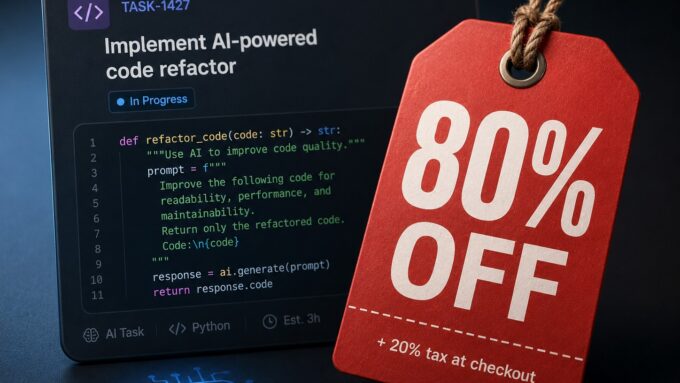
I realized I now have the same problem with AI tools. You get this feeling of near-infinite output potential because everything is “just a prompt away”. Everything feels cheap now. It’s like all my computer-related work is on sale, and so now I’m overbuying. I’m like the guy who loads up on way too much during Black Friday because he can’t pass up the deal, even if he doesn’t actually need the stuff he’s buying. I constantly end up with dozens of small feature branches stacking up in DevX of things that sounded easy, but got stuck in the mud of manual Jon work that AI couldn’t offload.
I’ve started calling this gap the 20% tax. AI is great at starting things and tackling that first 80% that used to feel so hard. The last 20% is all the stuff AI doesn’t really do yet like taste, deciding what to build, integration, real-world validation, final reviews and verifications you still end up doing, project overhead, etc. The constraint used to be can I build this? Now it’s a stack of 20% questions: should I build this? Is this the right version? The right architecture?
AI collapses the marginal cost of starting to essentially zero, but the marginal cost of finishing is the same or even grows because now I’m juggling it across even more projects or tasks. Ironically this just means I end up working more. It’s like the Jevons Paradox where these outputs all feel dramatically cheaper (even cheaper than they are), so I spin up more work and more stuff and end up working more than I used to – not less. In some ways this all feels like the same problem I talked about in Promptcrastination, but instead of avoiding certain tasks in a project it’s spinning up more new projects or tasks. It’s all the same root problem of the capability setting the agenda instead of my priorities setting it.
Let’s be honest, though, some of the extra 20%s are totally worth it. AI making the work cheaper does genuinely expand the frontier of what’s worth doing and this means higher leverage for doers who know how to use these tools to their maximum potential. The goal isn’t necessarily to start fewer things, it’s to make sure you’re still choosing the tasks and weighing the full cost of them. Not artificial scarcity, but deliberate constraint.
I think the way I’m going to address this is to start testing my own constraints. Put a cap on the number of works-in-progress and make sure I try to really evaluate the last 20% before I start anything. Then capture that last 20% and compare it to my prediction to try to get better at estimating this, especially since it’s likely a moving target as models and tools improve.
General Magic had seemingly every resource and no constraints, and ultimately it became a case study in the importance of constraints. AI gives us the same gift, but also the same challenge. The discipline we must all develop in the AI era isn’t better prompting, it’s fully pricing the 20% tax before you buy.